By Michael James, Director at Belvedere Drives Ltd
The best patio ideas for London gardens make a small or narrow space feel bigger and work hard all year. Large-format porcelain or sandstone slabs, diagonal layouts, a patio placed where the sun falls in the evening, built-in planters and seating walls, and split levels on sloping plots all help. Whatever the design, a patio lasts when it is laid on a proper base with the right falls for drainage.
- Larger slabs and fewer joints make small gardens look bigger and tidier.
- Laying slabs on the diagonal can make a narrow garden feel wider.
- Porcelain is low maintenance; Indian sandstone and brick give a warmer, natural look.
- Check where the sun falls at the times you use the garden before choosing the spot.
- A patio needs a firm sub-base and a gentle fall away from the house so rainwater drains.
- Most back garden patios do not need planning permission, but listed buildings and some conservation areas can have extra rules.
London gardens come in every shape: long, narrow strips behind Victorian terraces, compact courtyards, sloping plots and wide family gardens in the suburbs. A well-designed patio can make any of them more useful, giving you somewhere to eat, relax and spend time outside for more of the year.
These patio ideas focus on what works in real London gardens, from making a small space feel bigger to dealing with slopes, shade and drainage, so you can plan a patio that suits your home and the way you live.
Before you choose a patio design
A few practical questions shape every good patio:
- How will you use it? A dining table for six needs more space than a bench and a coffee table.
- Where does the sun fall? Watch the garden at the times you are most likely to sit out, often evenings and weekends.
- How level is the ground? Slopes may need steps or retaining walls.
- Where will rainwater go? London clay drains slowly, so the patio needs a fall and somewhere for water to run.
- What style is the house? The best patios pick up the colours and materials of the home.
Patio ideas for London gardens
Go large with porcelain in a small garden
Large-format porcelain slabs mean fewer joints, which makes a small garden look calmer and bigger. Choosing a colour close to the kitchen floor helps the patio feel like an extension of the room inside, especially with bi-fold or sliding doors.
Lay slabs on the diagonal in a narrow garden
Long, thin terrace gardens can feel like corridors. Laying slabs at an angle leads the eye across the space rather than straight to the back fence, which makes the garden feel wider.
Bring warmth with Indian sandstone
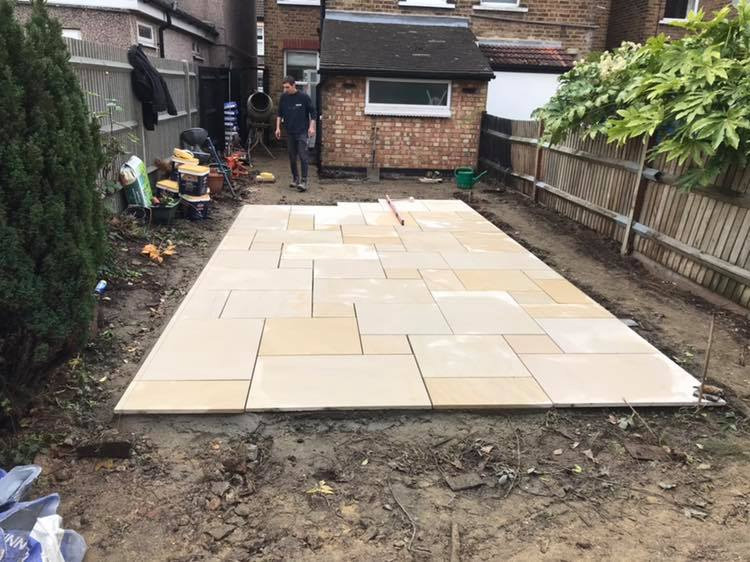
Indian sandstone has natural variation in colour and texture, so no two slabs look quite the same. It suits period homes and softer, planted gardens, and it ages well when it is sealed and cleaned from time to time.
Match brick to a Victorian or Edwardian home
Brick or clay pavers pick up the colour of London stock brick and red brick terraces. They work well as a full patio, a herringbone pattern near the house or a border around stone or porcelain slabs.
Mix materials for definition
Combining two materials, such as porcelain with a brick border or sandstone with a gravel strip, can mark out a dining area, frame planting or break up a large paved space without adding walls.
Follow the evening sun
The best spot is not always next to the back door. In many gardens, a second patio at the far end catches the last of the evening sun, while a small terrace by the house works for morning coffee. A simple path links the two.
Build a split-level patio on a sloping plot
Instead of fighting a slope, use it. A raised patio near the house with steps down to a lawn, or two terraces at different levels, creates separate spaces and makes the garden easier to use. Retaining walls and steps need to be built properly to hold the ground.
Add built-in planters and seating walls
Low brick or rendered walls around the edge of a patio can double as extra seating and as raised beds for planting. In a small garden, this saves space that loose furniture and pots would take up.
Use the same material for paths and patio
Running the patio material into the path that leads down the garden or round to the side return makes the whole outdoor space feel planned and connected, rather than a set of separate pieces.
Plan lighting from the start
Low-level lights set into steps, walls or planters make the patio usable on autumn evenings and add depth to the garden after dark. Cables and fittings are much easier to run before the patio is laid, and should be installed by a qualified electrician.
Leave room for planting
Paving the whole garden can make it feel hard and can add to drainage problems. Leaving beds, a strip of lawn or gravel areas around the patio softens the design and gives rainwater somewhere to go.
Choosing a patio material
| Material | Look | Upkeep | Good for |
|---|---|---|---|
| Porcelain | Clean, modern, consistent colour | Low: resists staining, easy to wash | Small gardens, contemporary homes, linking indoors and out |
| Indian sandstone | Natural, varied tones and texture | Medium: occasional cleaning, sealing helps | Period homes and planted, relaxed gardens |
| Concrete slabs | Simple and practical | Medium | Straightforward, functional patios |
| Brick or clay pavers | Traditional, warm, patterned | Medium: joints need topping up over time | Victorian and Edwardian houses, borders and paths |
What makes a patio last
Most patio problems, such as rocking slabs, puddles and cracked joints, come from what is underneath rather than the slabs themselves. A long-lasting patio needs:
- the ground dug out and a firm, compacted sub-base laid
- a gentle fall away from the house, so rainwater runs off rather than towards the walls
- the finished level kept well below the damp proof course of the house
- slabs laid on a full bed of mortar, with joints filled properly
- drainage, such as a channel drain or soakaway, where water has nowhere else to go
Do you need planning permission for a patio?
Most patios in back gardens do not need planning permission. If your home is a listed building, or in a conservation area with extra controls, check with your council first, as parts of North London such as Hampstead and Highgate have conservation areas. Paving a front garden is different: covering more than 5 square metres with a surface that drains onto the road needs permission, so permeable materials or drainage into a border are the usual answer.
Bringing your patio idea to life
The right design depends on your garden’s size, levels, light and how you want to use it. Belvedere Drives Ltd provides patio installation across North London in porcelain, Indian sandstone, concrete and brick, with the groundwork done properly underneath. If your plans go beyond the patio, our landscaping contractors can bring in fencing, turf and planting areas, and our garden walling work covers raised beds, retaining walls and steps for sloping gardens.
Mark it out before you decide
Use garden hose or string to mark the patio shape on the ground, then put your table and chairs inside it. Leave it for a few days and check how much space you have to move around and where the sun falls. It is the easiest way to get the size right.
Ready for a new patio?
Belvedere Drives Ltd is a North London paving and landscaping company with 15 years of experience. We design and build patios for gardens across North London. Find out more about our patio installation.
Frequently asked questions
What is the best patio material for a small London garden?
Porcelain is a popular choice for small gardens because large slabs and tight joints make the space look bigger, and it is easy to keep clean. Indian sandstone and brick suit period homes if you want a warmer, more natural look.
How big should a patio be?
Allow enough room for your furniture plus space to walk around it comfortably. Marking the shape out on the ground with your table and chairs in place is the simplest way to check before you commit.
Which way should a patio face?
South and west-facing spots get the most afternoon and evening sun, but the best position is wherever the sun falls when you actually use the garden. In some gardens that means a patio away from the house.
Do I need planning permission for a patio?
Most back garden patios do not need planning permission. Listed buildings and some conservation areas can have extra rules, and paving more than 5 square metres of a front garden with a surface that drains onto the road needs permission.
How long does it take to lay a new patio?
Most standard patios take a few days to a week, depending on the size, the material and how much digging out, levelling or drainage work is needed. Steps, walls and lighting add time.

Written by Michael James Delaney, Director at Belvedere Drives Ltd.
Michael leads the company's driveway, paving and landscaping work for homeowners across North London, including Barnet, Enfield, Finchley, Hampstead and Southgate. View profile